About us

Welcome to BBIH

Our School

At BBIH, we believe that every young person deserves to feel safe and supported. Our vision is to empower each learner with the confidence, skills, and sense of purpose they need to lead a happy, healthy, and successful life beyond school.

Many of our students have experienced barriers in mainstream education. We provide the second chance they need—through flexible, high-expectation, and relational teaching that enables every learner to redefine what’s possible for themselves.

We are proud to offer an alternative, rigorous progression route for students whose needs have not been met elsewhere. Our personalised and careers-centred curriculum is designed to reconnect young people with their learning—by linking education to their real lives, aspirations, and futures.

At BBIH, success isn’t about fitting into a traditional mould—it’s about achieving personal growth and learning to be ambitious. Our curriculum offers aspirational, work-related qualifications at GCSE level and equivalent, supported by a mentoring programme that puts students at the centre of their journey.

We believe in inclusive education that values each individual, regardless of race, faith, gender, or background. Strong parental links, creative enrichment, and consistent high-quality teaching all underpin our work. Through this, we ensure our learners leave us with the resilience, independence, and social capital they need to live well and contribute positively to society.

At BBIH, we live our values: Leadership, Inclusion, Growth, Ambition, and Sustainability—in everything we do.

Kevin Howarth
Head of School, BBIH

For information on how we demonstrate compliance with the public sector equality duty, policies and accounts, please visit beaconacademytrust.co.uk

BMAT curriculum principles

we want our students to be:

  • Successful learners who enjoy learning, make progress
    and achieve their full potential.
  • Confident individuals who are able to lead safe, healthy
    and fulfilling lives.
  • Responsible citizens who make a positive contribution
    to society.

BMAT pupils study an ambitious, broad and balanced curriculum planned by subject experts

Curriculum planning begins from pupils’ starting points at KS2 and builds towards the end point in KS5. We meet the students where they are so all students are able to build on prior learning and be challenged across
all of their subjects.

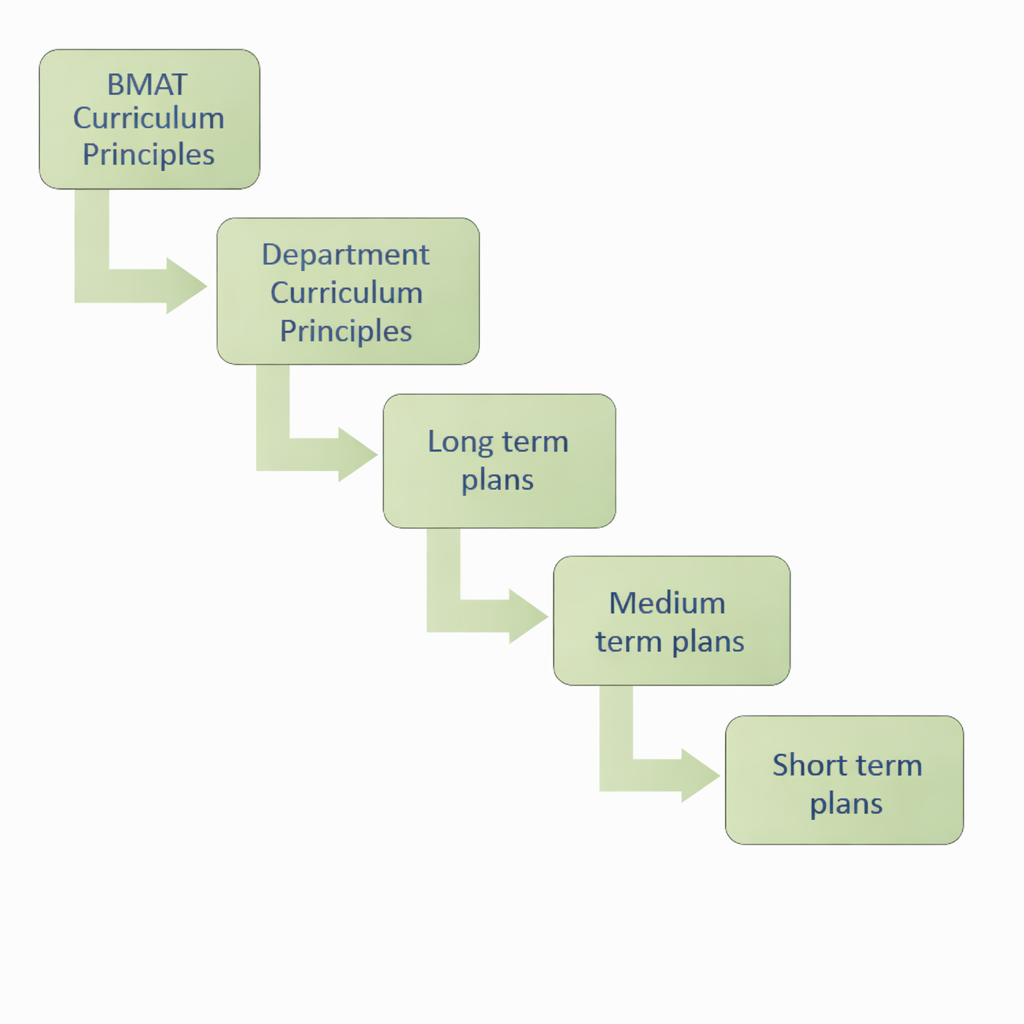
BMAT LEVELS OF PLANNING:

Department Curriculum Principles – at department level setting out their vision for learning the subject, how it takes
place and the key substantive and disciplinary developed.
Long term plans – setting out what will he taught and the order. Medium term plans – detailing exactly what the students will
learn and the pedagogical challenge.
BBIH - School Day timing
BBIH - Contact Us

SHORT TERM PLANS:

Short Term Plans are the core of our curriculum in every subject with detailed articulation of what the students need
to know and why, guiding our intellectual preparation. Every lesson is thoughtfully structured
with the BMAT Teaching Principles:

  • Lesson routines

  • Instructional core

  • Stretch and challenge

BMAT Teaching Principles

Retrieval practice
(Do Now)

Every lesson should begin with a ‘Do Now’/retrieval practice task designed to check for understanding of prior content, prerequisite knowledge or challenge thinking.

Students should complete the task as soon as they enter the classroom.

Teachers should circulate to ensure that students are on task and that their knowledge is accurate.

Review as a class through cold call questioning and stretch-it to test the validity of answers and link to prior learning.

Students should self-assess and correct answers where needed.

Teachers should address misconceptions and reteach if <80% correct.

When designing retrieval practice tasks, teachers should use the first few questions as a pre-requisite knowledge check and then finish with a dig deeper/challenge question to elicit higher-order thinking.

Direct Instruction
(I Do)

Teachers should present and communicate new ideas clearly, with concise, appropriate, engaging explanations and definitions based on expert subject knowledge.

Teachers should connect new ideas to what has previously been learned by re-activating and checking prior knowledge.

Teachers should use examples (and non-examples) appropriately to help learners understand and build connections.

Teachers should introduce new content and demonstrate new skills using effective modelling techniques (e.g. blank canvassing), which help students to move from the familiar to the unfamiliar or from the concrete to the abstract.

When introducing new content, teachers should take care not to introduce too much content at a time to avoid cognitive overload.

When modelling new content or concepts, teachers should consider the ‘direction of travel’ by first deciding what the ‘finished product’ looks like and then structuring their explanations accordingly.

Teaching to the top

Teachers should create a climate of high expectations, with high challenge and high trust.

Teachers should plan lessons to challenge the most able and maximise the amount of time that all students spend in the ‘struggle zone’ / ‘zone of proximal development’.

Teachers should ensure that students have access to the depth of knowledge and subject-specific vocabulary needed to engage with the subject and compete for top grades at the highest level.

Teachers should model and showcase benchmarks of brilliance to enable students to see what achievement looks like at key thresholds and understand how to get there.

When planning lessons and sequencing tasks, teachers should prioritise activities and CFU that encourage students to think hard and deeply about the most difficult concepts and transformative ideas in their subjects.

Teachers should provide scaffolding and support to make tasks accessible to all by anticipating potential barriers, including common misconceptions, SEND need, vocabulary, issues decoding written text, gaps in prior knowledge and the inherent complexity of the task

Learning aim

Every lesson should include a single, challenging, learning aim.

Teachers should refer to the learning aim explicitly to check that students understand what they are learning and why they are learning it e.g. “I will learn that… so that I can…”

Teachers should clearly signpost links between current, prior and future learning.

Planned tasks, activities and questioning should always be driven by the learning aim.

When designing learning aims, teachers should ‘front load’ the most challenging content and concepts.

Guided practice (we do)

Students should begin to apply the newly taught material in a structured way, but with the teacher actively involved. 

Teachers should provide students with appropriate scaffolds and support to make tasks accessible to all.

Teachers should observe students as they practise, provide immediate feedback, correct misconceptions, and reteach as needed. 

The teacher and students should work together, with the teacher providing more support initially, and gradually allowing students to do more independently by removing scaffolds (adaptive teaching).

Teachers should allow students to try out new skills with ongoing teacher support before moving to independent practice. 

Checking for understanding

Teachers should plan to use questioning and dialogue in the classroom to check for understanding and encourage students to think deeply.

As a rule, hands-up questioning should only be used to gauge students’ prior knowledge of a topic they have yet to study or when seeking a response to a question which has been designed to deepen the whole class’s learning or challenge them to think in a different way. Instead, teachers should focus on using the following whole school questioning techniques:

1. Cold calling
2. No opt out
3. Right is right
4. Stretch-it

Teachers should require students to use high-level, subject-specific language in their responses.

Teachers should plan for regular, structured opportunities for students to turn and talk to promote engagement and encourage high quality academic discussions.

Whole class checks for understanding should be deliberately planned throughout all lessons, inserted at points where misconceptions are likely to occur and where students transition from instruction to practice.

Teachers should use MWBs to check student understanding and ensure that they are ready to move into guided and then independent practice.

Plenary

Every lesson should include a plenary to be completed by students at the end of every lesson.

The plenary task should be designed to test students’ mastery of the crux of the learning objective and the extent to which it has been achieved.

Plenaries should be reviewed by the teacher and used to inform the planning of the next lesson, including areas requiring re-teach, re-testing or further practice.

Independent practice
(you do)

Students should be required to practise independently, in pairs or groups until learning is fluent and secure (‘overlearning’).

Independent practice should be planned to ensure students think hard about the material they have covered during direct instruction and guided practice.

Teachers should design independent practice tasks that embed and reinforce learning through repetition and retrieval, thereby facilitating transfer to students’ long-term memory and freeing up their working memory to apply their learning to new contexts.

Feedback

Teachers should respond to feedback from students by introducing appropriate micro-adaptations e.g. altering the pace of the lesson, modifying instructions or providing additional support.

Teachers should provide students with actionable formative and summative feedback to guide their learning.

Students should also be provided with feedback from their peers, during groupwork, and from marking their work during self-assessment.

Students should be encouraged to plan, regulate and monitor their own learning before setting themselves targets for improvement (metacognition)

Students should be provided with opportunities to ‘fix-it’ or redraft their work based on the feedback received.

Teachers should consider how feedback gained through assessment, impacts on the delivery of future lessons and the scheme of learning.

Planning Hierarchy

BMAT Teaching Principles underpin all of these levels of planning.

Intellectual preparation provides the bridge between medium/short term plans.